Posts

Showing posts with the label repentance

Idols With Clay Feet

Image
Pixabay I just finished throwing out two books. There was nothing wrong with the books, or the information that they contained. I also made a mental note to go through some study material that I wrote and taught several years ago to remove references to one of the books I have just consigned to the garbage. It's not the books, or the material. It's the author who wrote the books. I won't say that he has ever been an idol of mine. But I know that he has been the idol of others, world-famous in fact. He started a movement and became a guru among evangelicals, much quoted and much emulated. And perhaps everything he said and did (at least in his ministerial role) was exemplary and worthy to be followed. But it turns out he is an idol with clay feet, who has systematically abused his power over many years while in the ministry,  This abuse particularly relates to his relationship with women. As a woman, and one who knows a little about abuse of power in ministry, I don...

Times of...

Image
Pixabay A long spell of brutally hot, humid, weather was broken last night. This morning, as I went out into the backyard to fill the bird feeder and deadhead the pansies, the cool breeze and absence of humidity after last night's cold front and rain filled me with a sense of well-being. As I sat in my office later a familiar verse came to mind that seemed appropriate not only to the weather but for the world in general. It comes from Acts 3:19 and dovetailed perfectly with my verses of the day from John 3. Peter, preaching to the crowd in Jerusalem exhorts them to: " Repent, then, and turn to God, so that your sins may be wiped out, that times of refreshing may come from the Lord ." The oppression of sin, the guarantee of the fiery depths of hell, can be dealt with as forgiveness rains down, as the breeze of the Holy Spirit scatters the dying embers of all that holds us down and keeps us behind the fence away from relationship with our Heavenly Father. Repent...

More Than A Quick Visit to a Watering Hole

Image
Pixabay He was a novelty, a curiosity. People were tempted to keep their distance, just as they would today if they saw a scruffy man carrying a sign announcing the end of the world. At the same time, the little “bump” that insists on knowing what is going on would drive them to linger near enough to hear what he had to say. He was John the Baptist, the desert prophet and way-paver for Christ, the Messiah. His message? “ Repent, for the kingdom of heaven is near ” (Matthew 3:2). And if, and when, any of his listeners were willing to repent, “ Confessing their sins, they were baptized by him in the Jordan River ” (3:6). Public confession of sins is something we seldom see today, but it was the prerequisite for baptism—and still should be. But there was also a post-requisite that was to follow baptism. When the religious leaders came to John, he turned on them with this accusation: “ You brood of vipers! Who warned you to flee from the coming wrath? Produce fruit in keeping with repe...

Heart of Worship

Image
Pixabay When did the organized, communal worship of God begin? I don’t think I have ever asked that question before. But this morning my curiosity “bone” was tickled when I read this interesting phrase at the end of Genesis 4: “ At that time people began to call upon the name of the Lord ” (vs. 26). The context tells us that this happened around the time Adam and Eve’s third son, Seth, had a son of his own called Enosh. Experts calculate that this was some two hundred and forty years after the creation of Adam. It’s an odd phrase that seems to imply that before this people didn’t communicate with God. But we know that some did. The general consensus seems to agree with Matthew Poole’s comments: “ to call upon the name of the Lord; to pray unto God, to worship God in a more public and solemn manner; praying being here put for the whole worship of God, as Genesis 12:8, Genesis 26:25, and in many other places. According to the marginal version, the sense is this: Then when the world w...

Come Out of Hiding

Image
Pixabay What was your first reaction when, as a child, you did something wrong that you didn’t want your parents to find out about? Hide yourself or hide the evidence. Adam and Eve tried that. “ Then the eyes of both of them were opened, and they realized they were naked; so they sewed fig leaves together and made coverings for themselves. Then the man and his wife heard the sound of the Lord God as he was walking in the garden in the cool of the day, and they hid from the Lord God among the trees of the garden ” (Genesis 3:7, 8). I always got caught. So did Adam and Eve. On one of the rare occasions that I babysat the pastor’s kids, they behaved badly. When I threatened to tell their father, they pleaded with me for mercy. I granted their request and didn’t tell on them. Several days later I discovered that, burdened with guilt, they confessed what they had done to their father anyway! Adam and Eve got it wrong, and the kids got it right. It’s never good to try to hide our wrongdo...

Defrost

Image
Pixabay She lay in her bed shivering. "I can't get warm," she said. I turned up the heater as far as it would go and covered her with a third blanket. The room was stifling hot, but she was shaking with cold. I went to the desk to ask someone to get her yet another blanket. As concerned as I was about her physical coldness, I was more worried about her spiritual well-being. But at that moment, her mind was too engaged by her physical needs to allow room for anything else. This morning, as I prayed for her, I remembered again the promises of Scripture that are associated with the coming of Christ. He came to heal the frozen heart and the broken spirit. The last book of the Old Testament tells us: " But for you who revere my name, the sun of righteousness will rise with healing in his wings. And you will go out and leap like calves released from the stall " (Malachi 4:2). Who could have imagined that a baby, born without rank or privilege, could hold t...

Remember...What You Have Received

Image
Pixabay Remember...what you have received. When I was a kid and Christmas morning rolled around, there was a tradition that had to be observed. Every present that was received and opened had to be documented. What it was and who gave it was recorded. Immediately after Christmas thank you notes were written to the gift-givers and put into the mail. To neglect to acknowledge a gift was almost an unpardonable sin. The apostle John, exiled to the Isle of Patmos, received some messages from the Lord that were to be delivered to some of the churches in the region. One of those letters was to go to the church at Sardis. Of course, the principles outlined in these letters to the seven churches are also meant as messages to the church today—nothing much has changed given that human nature doesn't change no matter what century we are looking at. Sardis appeared to be a vibrant church (Revelation 3:1). God knew better. In the message, John was to write: " ...but you are dead ....

In God We Trust

Image
Pixabay It's long since gone the way of all things, but the plaque hung on a wall in my parents' home for many years. My mother was a worrier and I had bought it for her as a reminder, particularly while I was overseas, that God was looking after business and she didn't have to fret. " ...in quietness and trust is your strength " (Isaiah 30:15) writes the prophet. In its context, the verse is part of a broader message. It is, in fact, a call to return to the Lord. Israel struggled continually with putting her confidence in places and in people other than her God. She often trusted foreign kings and their armies to rescue her from other kings and their armies. Idol worship was always an issue—Israel took on the belief systems of her pagan neighbours, sometimes not replacing Yahweh, but adding other gods "in addition to...." Israel became like her pagan neighbours rather than being distinct from them as God had commanded her. Eventually this spirit...

My Chains Came Off

Image
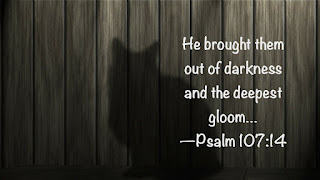
Pixabay There are few things as scary as being arrested in a third-world country. I know because I've been there. So when I read Psalm 107:10-16, I can relate. Here's what the psalmist says: " Some sat in darkness and the deepest gloom, prisoners suffering in iron chains, for they had rebelled against the words of God and despised the counsel of the Most High. So he subjected them to bitter labor; they stumbled, and there was no one to help. Then they cried to the Lord in their trouble, and he saved them from their distress. He brought them out of darkness and the deepest gloom and broke away their chains " (107:10-14). I was never chained, but I remember the " darkness and deepest gloom ." But the psalmist's words remind me of something far more frightening than ending up in a Colombian prison. They speak of the prison where lives every unrepentant person. This is the state of the soul who doesn't know Jesus Christ as only sufficient and per...

Consequences, Not Condemnation

Image
Pixabay I don't know why I think I can get away with it! But I suppose I am no different than most people in thinking that somehow God will overlook my "little" failures and follies. But offending God has its consequences, and eventually our failures and follies will come back to haunt all of us. And in case we don't think that our "little" ones are all that bad and God will overlook them, James 2:10 reminds us that to break one commandment is to break them all. And God will not let us off the hook. This was the warning issued by Moses in Numbers 32. Two and a half tribes of the twelve that had set out for the Promised Land had decided to settle east of the Jordan River. This was fine. But there was a condition. When it came time for God's people to cross over the river to take possession of what God had promised, the two and a half tribes were to enter the land with their brothers and help them conquer the Canaanites who lived there. Then and on...

Consequences, Not Condemnation

Image
Pixabay I don't know why I think I can get away with it! But I suppose I am no different than most people in thinking that somehow God will overlook my "little" failures and follies. But offending God has its consequences, and eventually our failures and follies will come back to haunt all of us. And in case we don't think that our "little" ones are all that bad and God will overlook them, James 2:10 reminds us that to break one commandment is to break them all. And God will not let us off the hook. This was the warning issued by Moses in Numbers 32. Two and a half tribes of the twelve that had set out for the Promised Land had decided to settle east of the Jordan River. This was fine. But there was a condition. When it came time for God's people to cross over the river to take possession of what God had promised, the two and a half tribes were to enter the land with their brothers and help them conquer the Canaanites who lived there. Then and on...

Just A Little More Time

Image
troymccomas.wordpress.com (Google Images) Pilate might have thought that somehow he had been able to wiggle his way out of assuming guilt for the death of Jesus, but now matter how carefully he washed his hands on that terrible day, other blood stains could not be removed. You see, Pilate had been responsible for many deaths during his reign as Rome’s representative in Jerusalem.  He might have excused his actions as simply “doing his duty.” After all, governors held the right of life and death in their hands as part of their mandate to preserve order. Absolution from guilt in those cases could be argued. But maybe not. In Luke 13:1-9, in the midst of one of His discourses, some Galileans brought Pilate to Jesus’ attention. They reminded Jesus that Pilate had sent his soldiers to kill some citizens of Galilee while they were in the Temple offering their sacrifices. Holy places were supposedly sacrosanct, untouchable. Pilate’s actions labeled him as the worst of the worst. The a...

Swept Clean and Put in Order, But Empty

Image
Google Images Perhaps it’s just because I choose to read them above others, but it seems as though more and more posts and articles are appearing on the subject of revival, and all that is implied by the word. This morning a pastor friend posted a plea for prayer for revival among our leaders, churches and believers. Shortly after I read his post, I turned to my reading of the day and was met by this passage from Matthew 12:38-45. Jesus is rebuking the Pharisees and religious authorities. They want Him to produce a “sign” to prove His authority. Jesus refuses. But He points them back to their roots, to a piece of history that they know only too well. He directs them to the story of Jonah and his mission to Nineveh. “ The men of Nineveh will stand up in the judgment with this generation and condemn it, for they repented at the preaching of Jonah; and now one greater than Jonah is here ” (Matthew 12:41). Roots. Repentance. Revival. The root, as Jesus implied, was not in another new s...

Forgiven: No Greater Blessing

Image
Google Images Why would a man invite someone whom he despised to supper? Simon the Pharisee did just that. He invited Jesus to dine with him. But his feelings were clear from the beginning. The accepted custom was for the host to ensure that a servant washed a guest’s feet as he entered: to relieve him of the dust from the road and refresh him for the meal. Simon did not do this (Luke 7:44). Neither did the Pharisee offer a kiss of friendship when Jesus came into his house (7:45). Certainly he never honoured the Lord by recognizing him by anointing him with oil (7:46). The signs were all there. This was an inquisition not an invitation to dinner. But one lone woman messed it all up. How “ a woman who had lived a sinful life ” (7:37) got into Simon’s dining  room is a mystery. Mind you, God does move in mysterious ways so it is quite possible that she walked in because God ensured that she was invisible to doorkeepers and servants. Simon saw her and was incensed. Jesus saw her a...

Few, Not Many

Image
elibvbid.blogspot.com (Google Images) There are many renditions of the photo you see on your left. But I think this is the version that once hung on a wall in the church of my childhood. It depicts what is described in Matthew 7:13, 14. “ Enter through the narrow gate. For wide is the gate and broad is the road that leads to destruction, and many enter through it. But small is the gate and narrow the road that leads to life, and only a few find it. ” This is not a message that we want to hear. The New King James version of the Scriptures uses the word “ difficult ” to describe the road that leads to life. Commenting on this, John MacArthur writes: “Christ continually emphasized the difficulty of following Him (Matt. 10:38; 16:24-25; John15:18-19; 16:1-3; cf. Acts 14:22). Salvation is by grace alone, but it is not easy. It calls for knowledge of the truth, repentance, submission to Christ as Lord, and a willingness to obey His will and Word . Cf. Matt. 19:16-28.” ( One Perfect Life ...

Blind Spots

Image
gopixpic.com (Google Images) Sometimes (perhaps more times than I care to admit) I am not too bright. I’ve been without internet on my laptop all weekend. I tried all the usual tricks to get it up and running but this morning I was finally driven to call my service provider. The gentleman on the other end began to ask me questions that I didn’t quite understand. I felt a little stupid, but then again when it comes to these things I AM a little stupid. Finally the problem got fixed—it turned out to be something simple—the presence of a splitter that for some reason wasn’t a problem until Friday morning, though it had been connected for years. So as I sit down right now to organize my thoughts on what I read in the Scriptures earlier today I realized that blind spots (a nicer way to say, “stupid”) happen to all of us. In Luke 5:1-11, the crowds have gathered to hear Jesus speak. Because there are so many of them and everyone is pressing for a front row seat, Jesus steps into a bo...

On Fire or In the Fire

Image
Google Images Thirty years of almost complete silence about Jesus comes to an end with the appearance of John the Baptist. Other than His brief appearance in the temple at age 12, we learn little about Jesus during His youth. But the Gospel is the story of a Saviour and that story is about is take flight. It is said that power corrupts and absolute power corrupts absolutely. Such was the situation when John made his first appearance in public. The Ceasars ruled from Rome—a reign both corrupt and malevolent. As the leader leads, so do the followers follow. Alfred Edersheim writes that this was the moment in history for either “ruin or regeneration” ( Jesus the Messiah , p. 177). The rot of Rome threatened to swallow its territories, including that of Palestine. The Jews resisted, but like the Borg’s warning to the Federation in Star Trek: The Next Generation , the message from Rome was this: “You will be assimilated. Resistance is futile.” In the midst of decay and desperation, ...

Pride Lines

Image
Google Images It’s a curious statement—until you check out the details behind it. In 2 Kings 15 we have a brief summary of the reign of Azariah (or Uzziah), king of Judah. He became king at the age of sixteen and remained king for fifty-two years. Verse 3 tells us: “ He did what was right in the eyes of the Lord, just as his father Amaziah had done .” All good, right? But here comes the curious statement. “ The Lord afflicted the king with leprosy until the day he died, and he lived in a separate house. Jotham the kings’s son had charge of the palace and governed the people of the land ” (15:5). Azariah, or Uzziah, was one of the good guys. So what happened that the Lord brought this affliction down upon him? The book of Kings doesn’t give us the details but a parallel account in 2 Chronicles 26 does. Uzziah, as he is called in Chronicles, was a great king. It was recorded that: “ …his fame spread as far as the border of Egypt, because he had become very powerful…he was greatly hel...

When You Think You've Gotten Away With Something...

Image
Google Images Second Samuel 11 and 12 records a sad episode in the life of David. I remember that whenever I mentioned David as an example of someone with whom God was pleased one of the ladies in my study group in Caracas would immediately remind me of these sordid events. Yes, David wasn’t perfect—far from it—as these chapters prove. David should have been out leading his troops (2 Samuel 11:1). He did not look away when he should have (11:2). He yielded to the temptation to exercise his power wrongly and took what wasn’t his to take (11:3, 4). Knowing his actions would soon be discovered, he orchestrated the death of an innocent man, one of his faithful servants and soldiers (11:6-15). And the Scriptures say “ …the thing David had done displeased the Lord ” (11:27). In chapter 12 we read about how God’s servant, Nathan, confronted David about his sin and the king repented (12:13), recognizing that ultimately that what he had done was an offense against God. But the damage was do...

Streams of Mercy

Image
Google Images The Scriptures are full of grace stories. But then again, God’s grace is the point of the book! Tucked away in the middle of the adventures of David hides yet another example, another picture of the cross. 1 Samuel 25 tells us the familiar story of David’s encounter with Nabal. Let’s set the scene. David is still on the run from Saul. As the “Robin Hood” of his era, David and his men had occasion to act on behalf of the people in the neighbourhoods through which they traveled. Nabal appears to have been a wealthy landowner and sheep farmer. As the story goes, David’s men had provided a service for Nabal by protecting his shepherds and his sheep (25:7, 8, 15, 16). But when David asked for a few provisions for himself and his men, Nabal treated him with disdain and insult (25:10, 11), with the result that David set out to punish Nabal for his inhospitable attitude: “ It’s been useless—all my watching over this fellow’s property in the desert so that nothing of his is mi...