Posts

Showing posts with the label priorities

The Order of Things

Image
Google Images Having captured the ark of the covenant and defeated Israel’s army, the Philistines assumed that their god was greater than Israel’s God. 1 Samuel 5 to 7 describes how wrong they were. They first put the ark in their temple to share space with their god, Dagon (1 Samuel 5:2). On two separate occasions Dagon’s image ended up lying on the floor in front of the ark. The second time, the incident is reported this way: “ …there was Dagon, fallen on his face on the ground before the ark of the Lord! His head and hands had been broken off and were lying on the threshold; only his body remained ” (1 Samuel 5:4). To make matters worse, the people of Ashdod, where the ark was taken, were inflicted with disease  and it didn’t take a genius to determine that all these things had something to do with the God associated with Israel’s ark (5:7, 8). They moved the ark to Gath and then to Ekron and sent the population of those cities into panic mode. “ God’s hand was very heavy…” ...


Doing a Martha

Image
Google Images Martha is much maligned. Yes, the Lord did rebuke her for getting so uptight about the meal she was preparing for thirteen men (and what hostess wouldn’t be?) that she missed the spiritual meal that came from sitting at Jesus’ feet. Yes, she did that. But by the time we get to John 11, we find a different Martha. We find a woman with whom Jesus discussed the resurrection. Hmmmm, she must have been sitting at Jesus’ feet to have gotten that intelligent in a world where women were hardly educated in anything but washing, cooking, hauling water, and having babies. It was Martha who said: “ I believe that you are the Christ, the Son of God, who was to come into the world ” (John 11:27). Martha didn’t pick up that bit of good theology by scrubbing floors. As Jesus and His disciples approached Bethany, His arrival was announced at the house where Mary and Martha were mourning the loss of their brother, Lazarus. This time it was Martha who dropped everything and rushed...

Hypothetically speaking....

Image
Google Images How many times has someone said to you, “I know it’s a stupid question but....” At times we are tempted to say, “Yes, it IS a stupid question, so why are you wasting my time asking it?” Jesus must have been asked a lot of stupid questions and Matthew 22 records one of them. The Sadducees came calling, hoping to stump the Lord with a question on the resurrection. Since they didn’t believe in the resurrection, the question was an odd one for them to ask. I suppose they couldn’t come up with anything better. The law said that if a man died without a son to carry on his name, his widow was to marry another brother and have a child who would then inherit the dead man’s name and his possessions. The question, a hypothetical one, was about a woman who married seven brothers, all of who died without producing the required heir. So, whose wife would the woman be in heaven? Nobody’s wife, since there is no marriage in heaven (Matthew 22:30), was the Lord’s answer. End of discus...

Priorities and Promises

Image
Google Images Material possessions and worry go together like cheese and crackers. The second half of Matthew 6 deals with both. From verses 19 to 24, the Lord warns His listeners not to focus on gaining stuff that can be stolen, or destroyed. Rather, we are to work to gain what is eternal. “ ...store up for yourselves treasures in heaven, where moth and vermin do not destroy, and where thieves do no break in and steal ” (vs. 20). Why is that important? Verse 21 nails that down: “ For where your treasure is, there your heart will be also .” Our hearts and minds need to be directed toward those things that matter most to God. To focus elsewhere is to be blind, to be “in the dark” (vss 22, 23). We are then told that a choice has to be made. We have to decide to direct our attention to the things that matter to God or to concentrate on the stuff that will eventually be destroyed. We can’t do both (vs. 24). God isn’t just one of many priorities in our lives—He is THE priority. But it i...

Lessons From A Sunflower

Image
I accidentally grew three sunflowers in my balcony planter this summer. They were probably the result of some stray bird seed, but nevertheless there they were. In the beginning the sunflowers were quite pretty. But their beauty didn’t last long. Very quickly they petals began to dry up and turn brown. I wondered if the soil wasn’t deep enough for them or if they were lacking water. Then I realized that the death of one part of the plant was a natural part of the process that was bringing life to another part of the plant—the sunflowers seeds. As the petals died, the seeds were bring produced in the heart of the flower. I was reading John’s account of Jesus’ encounter with the Samaritan woman in John 4 this morning. When the disciples returned from hunting up some lunch, they discovered that Jesus had been busy doing ministry. They thought they had left Him to rest by the well. They were concerned. “ ‘Rabbi, eat something.’ But he said to them, ‘I have food to eat that you know nothi...

Heavenly Banking

Image
AppEngine Development (Google Images) The red light flashed on and off in my mind. “ Whoever can be trusted with very little can also be trusted with much, and whoever is dishonest with very little will also be dishonest with much. So if you have not been trustworthy in handling worldly wealth, who will trust you with true riches? ” (Luke 16:10, 11) The context is how we handle our worldly possessions and whether we possess them or they possess us. The bottom line is given to us in verses 13: “ You cannot serve both God and money. ” But what intrigued me this morning was that little phrase from verse 11: “ ...if you have not been trustworthy in handling worldly wealth, who will trust you with true riches .” Call me stupid, but I never noticed before what this verse was eluding to. I always thought that Jesus was saying that if we handled a little bit of money well, He’d give us more. The context is money, after all. And money is something our minds turn to all too frequently becaus...

Temporal or "Temple"

Image
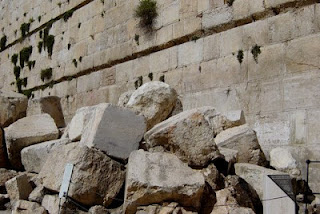
Ruins from temple mount, Google Images Between the events recorded at the end of Chronicles and the beginning of the book of Ezra, a couple of generations have passed. The exile is coming to a close and God is about to return His people to the land He had promised to Abraham. Ezra records that God put it in the heart of Cyrus, king of Persia, to allow the Jews to return to Jerusalem to rebuild the temple (Ezra 1:1-4). Then he writes: " Then the family heads of Judah and Benjamin, and the priests and Levites—everyone whose heart God had moved—prepared to go and build the house of the Lord in Jerusalem " (1:5, NIV). Just as the Egyptians had once given the Israelites provisions as they were leaving Egypt after their years of slavery in that country, so the Persians gave gifts to help the Jews in their return after their seventy years in captivity (1:6-11). The prophets of the days were Haggai and Zechariah and it is fascinating to read their books alongside the book of Ezra...

A Trade Imbalance

Image
Genesis 25 ends the story of Abraham and begins that of Isaac. Oddly enough, considering the Isaac was the son of promise, we know relatively little about him. It’s as though we skip a generation and go from the patriarch Abraham to the story of his grandchildren, Esau and Jacob. The twins had a pretty rocky relationship, aided and abetted by parents who showed too much favouritism. Esau was the eldest—by a hair, or a heel—so to him went the larger portion of the family inheritance. It was a great privilege but one that Esau didn’t value. One day, coming home from the hunt, he came across Jacob cooking up a pot of stew. Esau was hungry and bartered away his inheritance for the price of a bowl of red lentils. The Scripture records: “ So Esau despised his birthright ” (25:34, NIV). He threw away something of great value for something of little value. I got to thinking about how this story applies to me. As a child of God I have huge privileges. But how often to I “give away” thos...

He IS Coming Back–Honest!

Reading: Romans 12-14 In the days of the early church, the followers of Jesus expected the imminent return of the Lord. In part that explains the urgency they felt as they spread the Gospel to the far corners of their world. The Lord had left them a commission, a task to fulfill, and they were certain that the time was short in which to do what Jesus had asked of them. The imminent return of the Lord is something that has been preached, taught, sung about, and argued over, for centuries. These days we hardly hear a whisper about it. Those who fought over pre-, post-, and A-, have mostly gone on to heaven where they could now care less exactly how the Lord is going to return. We don’t sing much about heaven or about the Second Coming. With the aid of modern technology we live in a fantasy world where someone, somewhere, will let us know via Skype or FACEBOOK when all the nations of the world have heard the Gospel and then we can worry about getting our house in order for the L...

My House, Or Yours?

“ Give careful thought to your ways. You have planted much, but have harvested little. You eat, but never have enough. You drink, but never have your fill. You put on clothes, but are not warm. You earn wages, only to put them in a purse with holes in it ” —Haggai 1:6, NIV. Two short chapters, that’s the Book of Haggai. It only goes to prove that you don’t need a lot of words to say a lot, as contradictory as that may sound! The issue in Haggai’s day was the devotion of the people to building and beautifying their own homes while the temple lays in ruins (1:4). Transported to New Testament, post-Pentecost times, we know that the physical building called “church” is not the issue (though we shouldn’t leave that in ruins either!). Believers are, says Paul in 2 Corinthians 6:16: “ ...the temple of the living God ,” as he warns his listeners not to allow anything or anyone to distract them from a life of righteousness. Haggai’s message is a call to look at life realistically. Why i...

Dead, But Very Much Alive

The Galatian church was having "issues." People had crept into the church and were trying to persuade the believers to retain some of the old beliefs from which the Gospel of Jesus Christ had freed them. Paul called them on their drift back into the old and unproductive paths of believing that obedience to the law could save them. He even went so far as to call them "foolish" (Galatians 3:1). He recalled the uneasy meeting that took place between himself and the apostles in Jerusalem. The leaders of the early church were uneasy because in those early days after Paul's conversion, the believers were not entirely convinced that this "conversion" was another more than an elaborate hoax to trap them. Some of the Jews were still struggling with the entrance of the Gentiles into the Kingdom. Paul's claim to be an apostle to those Gentiles made him even more suspect to some. Paul was equally uneasy, uncertain about the reception he would receive from ...

While I'm Passing Through . . .

I read an excellent post this morning written by a friend ( http://brendaflemming.blogspot.com/2010/10/lord-you-are-my-home.html ). It was a reminder to me about how important perspective is in determining what our priorities in life need to be. Added to Brenda's post was an interesting incident that I read about in my devotions this morning. Jesus was coming to end of his earthly ministry and in one of those last discourses he spoke to his disciples about what was to come in the future. Among the things he said was this: " No one knows about that day [the coming of the Lord] or hour, not even the angels in heaven, nor the Son, but only the Father. Be on guard! You do not know when that time will come. It's like a man going away: He leaves his house in charge of his servants, each with his assigned task, and tells the one at the door to keep watch. Therefore keep watch because you do not know when the owner of the house will come back–whether in the evening, or at midn...

Focus On the Giver Before the Gifts

Well, I got past the first few words of Romans 1:1 (see yesterday's post) but not far. These days I'm juggling more balls than is sometimes comfortable and one of those "balls" is a workshop I'm preparing on spiritual gifts. I collected all kinds of resources on the subject—and there are lots out there—including a little book by Henry and Mel Blackaby called: What's So Spiritual About Your Gifts? Sometimes the balls I am trying to juggle get in each other's way and such was the case yesterday as I moved passed Paul's reference to himself as a servant of Jesus Christ. Here's the verse again: " Paul, a servant of Christ Jesus, called to an apostle and set apart for the gospel of God— " Romans 1:1, NIV. The Blackabys' book has an unusual perspective (unfortunately) on spiritual gifts. I say "unfortunately" not because I believe they are wrong, but because that perspective is unusual in our "me" society where belie...

After the Here-And-Now

If you can't touch it, you don't have to believe in it. If the truth is not in your face, slapping your cheeks, wearing a "pay attention to me" grimace, then it must be a figment of someone's imagination. Ignore it and it will go away—you hope. After all, the important thing is who has the most toys, isn't it? The here-and-now, like a petulant child, demands your attention. Your insecurities whisper sweet nothings in your ears, begging you to get more, get ahead, get moving with the current of the world. You listen; they are, after all, your insecurities. And then Jesus comes along and asks a huge question: " What good is it for a man to gain the whole world, yet forfeit his soul " —Mark 8:36. Every time something breaks, has to be replaced, crumbles, disappears, you are reminded that nothing is permanent except that very intangible that you work so hard to ignore. But after the here-and-now, that intangible is what is left. Investing in it might not...

I Wonder If Jesus Ever Got Homesick

He was always surrounded, but stood alone; understanding, but seldom understood. People had expectations of Christ. Surely, He would throw out the Romans and return Palestine to its rightful owners. Without doubt, He would do miracles and all that was evil in the world: hunger, sickness, war, would go away forever. Palestine stayed in Roman hands, and evil continued. He led, but His followers sometimes wandered off on other trails, pursuing rabbits instead of righteousness. He taught eternal truths to men with temporal minds. Like oil and water, they sometimes didn't mix. Christ's mission was often misunderstood, even by those closest to Him. In the end, the vast crowds that had followed Him eagerly, dissipated. These "friends" were replaced by crowds who wanted Him dead. Sometimes the familiar faces in one were the same faces that appeared in the other. Did Jesus ever wish He could just go home? Hebrews tells us that Jesus was tempted in every way that we can be temp...

My Fort Knox - Part 2

When does providing for your family turn into an obsession with more? When does making a living become living for the making of that living? Jesus is almost brutal in this statement in Matthew: " No one can serve two masters. Either he will hate the one and love the other, or he will be devoted to the one and despise the other. You cannot serve both God and Money " —Matthew 6:24. We tend to focus on the word " money " in this verse, but perhaps we would have a better understanding of what Jesus is saying if we considered these words: " serve ," " love ," and " devoted ." Those words should only apply to our relationship with God. When they apply to our relationship with the world, then we are in big trouble. Then we have not only divided loyalties, but only one loyalty. And wherever those words apply is where our " treasure " is stored (See yesterday's post). The Lord isn't saying that making a living and loving God, a...

Spring Cleaning

Life gets so busy just being life. There are times when God has to call us to take a timeout to reorder our priorities. Like spring cleaning, we have to throw out the clutter in our spiritual lives and rid ourselves of things that keep us from God's best design for us. That was the challenge that Haggai presented to the exiles who had returned to Jerusalem from their long captivity. They had gotten so involved with rebuilding their own lives, that they had neglected what God wanted them to concentrate on. And they wondered why rebuilding their own fortunes wasn't going so well. Haggai calls them to reorganize their priorities. " Now this is what the Lord Almighty says: 'Give careful thought to your ways. You have planted much, but have harvested little. You eat, but never have enough. You drink, but never have your fill. You put on clothes, but are not warm. You earn wages, only to put them in a purse with holes in it " (Haggai 1:5, 6). It was time to clean away ...